Most classrooms have a poster of shapes. Often there is only one example of each shape, with a 'standard' appearance.
-
The triangle is usually acute-angled with a horizontal base.
-
The quadrilaterals, other than kites, usually have one or two horizontal sides and therefore some of them also have vertical sides.
-
The trapezium usually has two (or three) equal sides with the longer side on the base and a shorter side above it.
-
The rectangle usually has the longer side on the base.
-
The pentagon is usually regular, with one side horizontal.
-
The hexagon is usually regular, with a pair of sides horizontal or vertical.
-
All the shapes are convex.
Pattern blocks, which are used frequently in primary classrooms, reinforce this standard perception.
What shape is a baseball 'diamond'? It is a square.
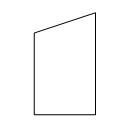
What shape is this?
You can download the Naming Polygons: Information Sheet, Regular and Irregular Polygons: Information Sheet and the Convex and Non-convex Polygons: Information Sheet which provide more varied examples.
Is this a hexagon?
The hierarchical system used for naming and classifying polygons can cause confusion. For quadrilaterals, the inclusive nature of the definitions can also create misunderstanding.
Pattern block hexagons
This is a practical activity using patterns blocks which encourages students to think more inclusively about hexagons.
Hexagonal tangrams
In this activity, students use a tangram to explore a wide variety of hexagons.