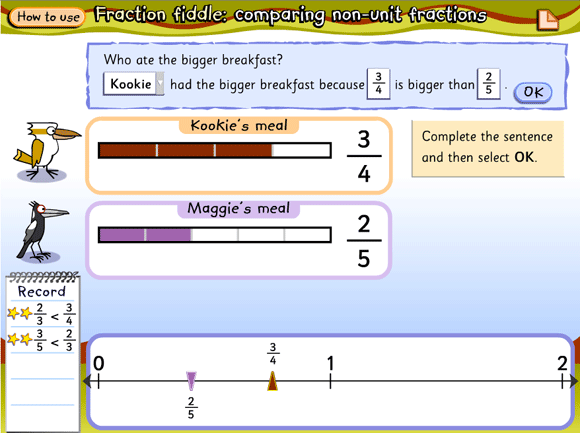
Display the learning object L2803 Fraction fiddle: comparing non-unit fractions to the class on an interactive whiteboard (or projector and screen).
-
Work through a task together, pausing for students to make predictions.
-
Which fraction do you think is smaller/larger?
-
Why do you think that?
-
-
Encourage students to notice the relationships between the numerator/denominator and the construction of the fraction bar.
-
What happens to the bar as the denominator gets larger?
-
What happens to the bar as the numerator gets larger?
-
-
Encourage students to notice the position of the fractions on the number line.
-
Look where \(\frac{3}{4}\) is located. Where would \(\frac{1}{4}\) be? What about \(\frac{1}{2}\)?
-
Is \(\frac{2}{5}\) going to be closer to 1 than \(\frac{3}{4}\) or further away? Why do you think so?
-
Students can work in pairs at computers to complete a set of tasks. The printed record of their findings can be the basis of further discussions about strategies for solving similar tasks without the learning object.
-
What can you do to help you work out which fraction is larger or smaller?
-
Why can’t you decide just by looking at the denominators?