Exploration of repeating patterns can form an easy introduction to some of the fundamental ideas of early mathematics.
Here is a very simple repeating pattern made from coloured blocks. It is called a 'train'.
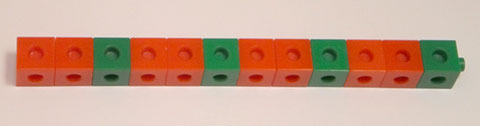
By talking about this pattern, students can come up with the following ideas.
-
The number of blocks is 1, 2, 3; 4, 5, 6; 7, 8, 9; 10, 11, 12 (rhythmic counting).
-
The number of blocks is 3, 6, 9, 12 (skip counting).
-
There are 4 lots of 3 blocks, making 12 blocks in all.
-
Each unit of repeat is a quarter of the whole object.
After exploring many other similar trains, students could reach some more general ideas.
-
To find the number of blocks in a train, you multiply the number of blocks in the unit of repeat by the number of repetitions.
-
To find the number of repetitions needed to make a train of a given size, you divide the total number of blocks by the number of blocks in the unit of repeat.
-
A number is even if you can make a train with that number of blocks using a unit of repeat consisting of two blocks. If not, the number is odd.
Can you see any other general ideas here?