Finding one-third of a number is the same as dividing by three, and can be represented with materials in a similar way.
For example, \(\frac{1}{3}\) of 12 and 12 ÷ 3 could both be modelled using 12 counters partitioned into three equal groups of four.

The mathematical relations suggested by the three equal groups of four counters are:
|
3 \(\times\) 4 |
= 12 |
|
12 ÷ 3 |
= 4 |
|
\(\frac{1}{3}\) of 12 |
= 4 |
Working with fractions of collections is helped by a sound knowledge of factors and multiples.
Using arrays and area grids strengthens the relationships between multiplication, division and fractions, by making the inverse relations more apparent.
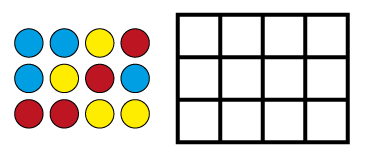
|
3 \(\times\) 4 |
= 12 |
4 \(\times\) 3 |
= 12 |
|
12 ÷ 3 |
= 4 |
12 ÷ 4 |
= 3 |
|
\(\frac{1}{3}\) of 12 |
= 4 |
\(\frac{1}{4}\) of 12 |
= 3 |
Fractions also appear in whole-number division when remainders occur.
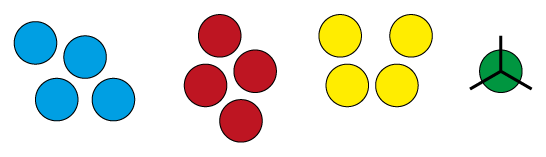
For example, \(\frac{1}{3}\) of 13 (or 13 ÷ 3) results in 4 remainder 1. The remainder 1 can be partitioned into three equal parts and the sharing process continued, leading to the mixed-number answer \(4\frac{1}{3}\).
Part and wholes
Students develop strategies for working out the total number in a collection, given the number of items in the fractional part.
Divide it up
Sharing-as-division problems may give a result with a remainder. In some contexts it makes sense to divide the remainder into equal parts (fractions) and continue the sharing process.